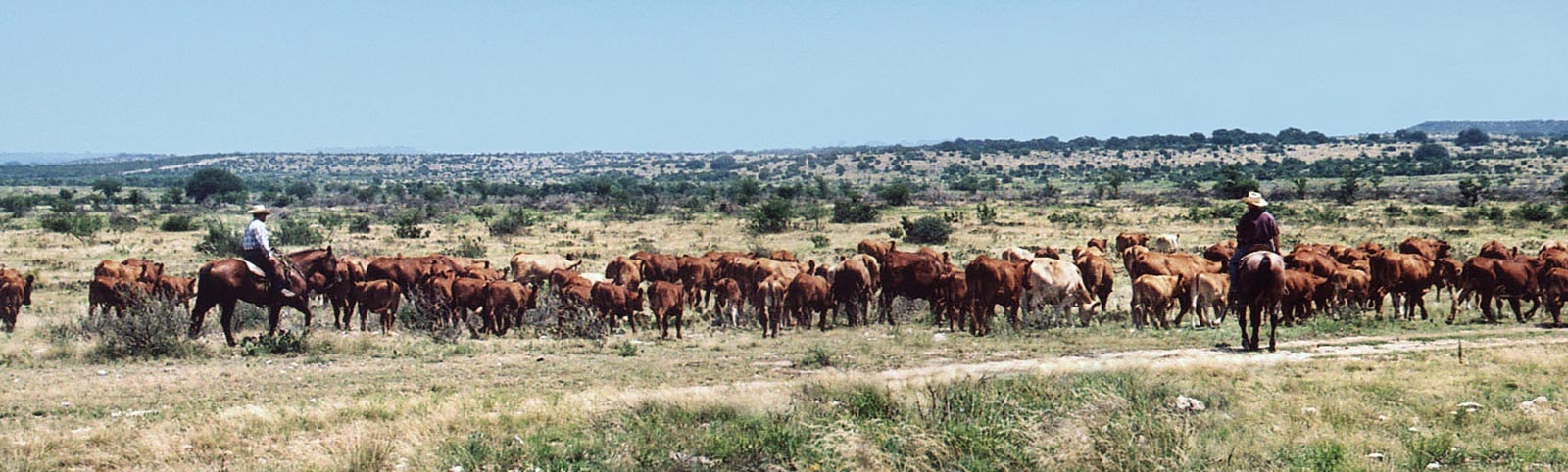

From the Winter 2026 issue of the Isa Informer
By Lorenzo Lasater, President
Crossbreeding is one of the most reliable and proven tools available to commercial cattlemen. Yet in an industry that constantly cycles through new trends, single-trait selection, and pressure to chase the next big thing, heterosis—often called hybrid vigor—is frequently undervalued or misunderstood. A major study published in 2025 by the U.S. Meat Animal Research Center (USDA-MARC) brings heterosis back into focus with some of the clearest data ever assembled on how crossbreeding affects growth, maternal performance, and carcass value in beef cattle.
Heterosis is obviously tightly linked to what we do at Isa Beefmasters. The breed originated as a three-breed composite in the 1930s, packing high levels of built-in heterosis into the gene pool. But it is also a crucial component of our genetic program today, as folks in North America search for a way to regain the positive effects of heterosis in a predominately Angus beef cow herd. In addition, many of our international customers have turned to Beefmasters to improve the productivity of their native cattle breeds.
The USDA research is part of the long-running Germplasm Evaluation Program, which began incorporating direct comparisons between purebred and crossbred cattle in the late 1990s. The earliest animals used in this dataset were born in 1999 and 2000, and in 2007 the program transitioned into a continuous, year-after-year evaluation of the most influential beef breeds in the United States. As a result, the findings in this study are not based on a short-term snapshot but rather reflect more than 25 years of data collected from over 28,000 animals under carefully controlled conditions.
The study evaluated 18 of the most widely used beef breeds in the U.S., including major British and Continental breeds as well as the American composites Beefmaster, Brangus, and Santa Gertrudis. Researchers measured a wide range of economically important traits, including birth weight, adjusted weaning weight, postweaning gain, ribeye area, fat thickness, marbling, and carcass weight. Two forms of heterosis were examined: heterosis between biological breed groups such as British, Continental, and Brahman, and the average heterotic advantage that each breed contributes when crossed with other breeds.
One of the most important conclusions from the study was that crosses containing Brahman influence consistently generated the greatest levels of heterosis. This result is not surprising from a genetic standpoint, as Bos indicus cattle, such as Brahman, are more distantly related to Bos taurus cattle than British and Continental breeds are to one another. That genetic distance translates into stronger hybrid vigor when the breeds are crossed. What is notable, however, is how large and consistent those advantages were across nearly every trait measured.
Calves from Brahman-influenced crosses were significantly heavier at weaning, gained more weight after weaning, and produced heavier carcasses than calves from British or Continental crosses alone. Maternal heterosis was also strongest in cows with Brahman influence, resulting in heavier calves at weaning simply due to improved milk production, mothering ability, and overall cow efficiency. These advantages extended beyond the calf crop and into the longevity and productivity of the cow herd itself.
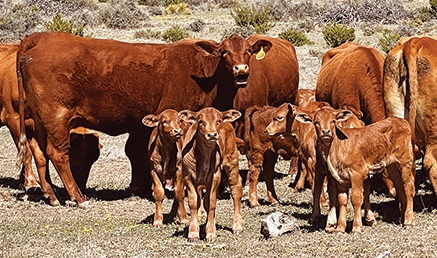 These days-old calves exemplify the Beefmaster advantage: low birthweight, high-gaining calves born from efficient, long-lasting, powerhouse mothers. This formula is the critical to ranching success.
Among all breeds evaluated, Beefmasters stood out as one of the strongest contributors of heterosis. Beefmaster crosses delivered the highest weaning weight heterosis of any breed in the study and ranked among the top for postweaning gain and carcass weight. In fact, Beefmaster crosses produced substantially heavier carcasses than British or Continental breeds and outperformed other American composites in most growth and carcass traits. These results reflect the balanced genetic foundation of the Beefmaster breed, which combines Brahman influence for adaptability and hybrid vigor with Hereford and Shorthorn influence for maternal strength, efficiency, and carcass quality. It is important to note that two Isa Beefmasters sires were used over the course of the study.
Another key takeaway from the study is that Beefmasters deliver heterosis without sacrificing carcass performance. While Brahman influence has historically been associated with concerns about carcass quality, the data show that Beefmaster crosses exhibit increases in ribeye area and carcass weight, along with improved finishing ability. Decades of selection within the Beefmaster breed have aligned it with modern market demands, allowing producers to capture hybrid vigor while still producing cattle that perform well on the rail.
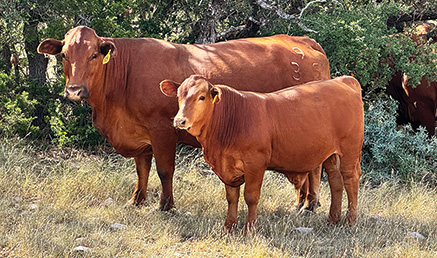 This six-year-old cow is raising her fourth calf during a hot, dry summer. The study found Beefmasters weaned significantly heavier calves due to their maternal strengths.
The economic implications of these findings are significant: Heterosis represents added production that does not require additional feed, labor, or land. Heavier calves, more efficient gains, and longer-lasting cows translate directly into higher returns per cow exposed. Depending on market conditions, the heterosis advantage documented in the study can easily add several hundred dollars of value per calf over time, especially when maternal performance is included in the calculation.
One particularly interesting outcome of the research was the comparison among American composite breeds. While Beefmasters consistently showed strong and significant heterosis effects across multiple traits, other composites such as Brangus and Santa Gertrudis did not demonstrate the same level of advantage in this dataset. This finding suggests that the unique genetic balance within Beefmaster cattle may be especially effective at maximizing hybrid vigor in commercial crossbreeding systems.
After more than 25 years of continuous evaluation, the USDA-MARC study delivers a clear and practical message: Heterosis remains one of the most powerful tools available to beef producers, and breeds that maximize heterosis offer a measurable competitive advantage. Beefmasters, in particular, stand out as a breed that consistently delivers hybrid vigor in growth, maternal performance, and carcass value.
In an industry where efficiency and adaptability are increasingly critical, heterosis is not optional—it is essential. And the data proves that Beefmasters deliver it in spades. We believe Isa Beefmasters genetics are best positioned to help our customers maximize heterosis and production efficiencies in their own herds.
Note: Read the full USDA-MARC study at: https://isabeefmasters.com/articles_post/usda-marc-study/

Connect With Us


Powered by:
 Translate
© ISA BEEFMASTERS 1996-2024 ALL RIGHTS RESERVED.